The article by the O. M. Marzieiev Institute for Public Health of the National Academy of Medical Sciences of Ukraine, “Current State of Hygienic Regulation of Radio-Frequency Electromagnetic Radiation,” raises an important issue: in recent years, Ukraine has revised sanitary standards regulating permissible levels of electromagnetic fields several times. It is especially important that these changes were connected not only with medical or hygienic research, but also with the development of mobile communications, LTE, mobile internet and digital infrastructure.
The authors of the article note that the changes to the standards were initiated by mobile network operators, and that permissible levels of electromagnetic fields were significantly increased. In particular, the previously applicable levels were gradually raised: first to 10 μW/cm² and 6 V/m, and later to 100 μW/cm² or 19.42 V/m for a number of radio-technical facilities. The article also mentions proposals for further increasing the standards — up to 208–450 μW/cm² depending on the frequency range.
The most notable conclusion of the article is that the initial maximum permissible levels expressed in μW/cm² may be increased by 83.2–180 times, while the levels expressed in V/m may be increased by 9.3–13.7 times.
Why This Matters for Personal Protection
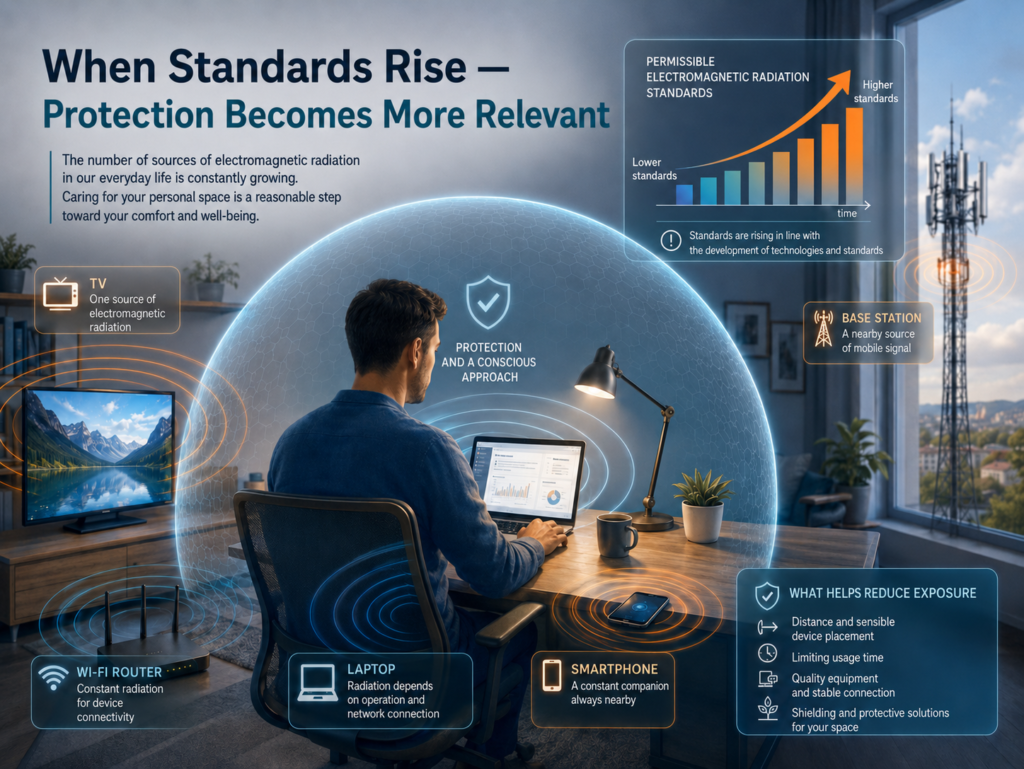
Our position is that long-term and constant exposure to electromagnetic radiation from any man-made sources should not be considered completely harmless. Even if a single source remains within the current standards, the combined exposure from mobile phones, Wi-Fi, laptops, household appliances, communication base stations and other sources may have a cumulative effect over time.
Therefore, as with low doses of radiation, it is more reasonable to follow the principle of minimizing exposure rather than waiting until the consequences of long-term exposure become obvious to everyone.
The Temporary Nature of the New Levels
Special attention should also be paid to the fact that the new levels were approved as temporary for five years, because under martial law it is impossible to conduct full-scale scientific studies to justify the proposed changes. In other words, this does not mean that the issue of the effects of electromagnetic radiation has been finally settled. Rather, it reflects a compromise between the development of communications, state priorities and sanitary regulation.
What This Means for Ordinary People
For an ordinary person, the main conclusion is simple: even if the new standards are considered permissible at the state level, this does not cancel a person’s right to take additional precautions in everyday life.
Today, sources of electromagnetic exposure surround us constantly: mobile phones, Wi-Fi routers, laptops, televisions, communication base stations and 4G/5G infrastructure. And if permissible exposure levels are being revised upward, interest in personal protective solutions becomes logical and understandable.
The Role of Spinor, Forpost-1 and Vernada Geo Devices
Spinor, Forpost-1 and Vernada Geo devices belong to this category of solutions — for those who do not want to wait for final scientific debates and prefer to reduce potential exposure in their personal space.
They should be viewed not as a replacement for sanitary standards or medical recommendations, but as an additional element of reasonable precaution in today’s technology-saturated environment.
This article is important not because it simply frightens people, but because it shows reality: the electromagnetic environment around us is changing, regulations are being revised, and the number of radiation sources continues to grow.
That is why protection from electromagnetic exposure is not an outdated topic. On the contrary, it is becoming an increasingly relevant part of caring for quality of life, the workplace and the home environment.